Understand how the "foreign agent" stigma impacts organisations and individuals
Dive deep into the evolution of “foreign agents” legislation in Russia between 2012 and 2024.
Pay attention and investigate which parts of society were impacted through this authoritarian practice.
You will have the opportunity to test your knowledge at the next stage, so let’s get started!
To complete the task, grab and move the panorama, click on all 15 hotspots and read the text.
Highlight which groups were negatively impacted by “foreign agents” legislation in Russia. You can select multiple groups and submit your answer. If you guess incorrectly, no worries, you have three attempts in total.
Тут текст описания человека или профессии 1
You’re correct!
Explainer: Multiple sectors of society were deeply affected by the foreign agents’ laws — from popular independent TV channels to individual comedians. Later versions of the laws also deeply affected educators, publishing houses, and bookshops. The stigma of being labelled “foreign agents” created mistrust among audiences and donors, making it impossible for these groups to continue working as they had before the designation. In contrast, the state sector — for example, civil servants, government-funded organizations, and state-sponsored media — was largely unaffected.
Good attempt. Here’s the correct answer.
The groups that were negatively impacted by “foreign agents” legislation in Russia include:
Climate justice NGOs
Public health NGOs
Human rights NGOs and lawyers
Human rights activists and educators
Election observers
Trade unions and associations
Independent media and journalists
Dissenting public opinion-makers
Writers, artists and musicians critical of authorities
Pro-government media outlets, State-aligned NGOs (GONGOs) and State officials do not belong to the targeted groups.
Not quite — give it another try.
Explainer: Multiple sectors of society were deeply affected by the foreign agents’ laws — from popular independent TV channels to individual comedians. Later versions of the laws also deeply affected educators, publishing houses, and bookshops. The stigma of being labelled “foreign agents” created mistrust among audiences and donors, making it impossible for these groups to continue working as they had before the designation. In contrast, the state sector — for example, civil servants, government-funded organizations, and state-sponsored media — was largely unaffected.
Read the case cards and identify which articles of the European Convention on Human Rights were violated. Don’t fear mistakes, we are here to learn!
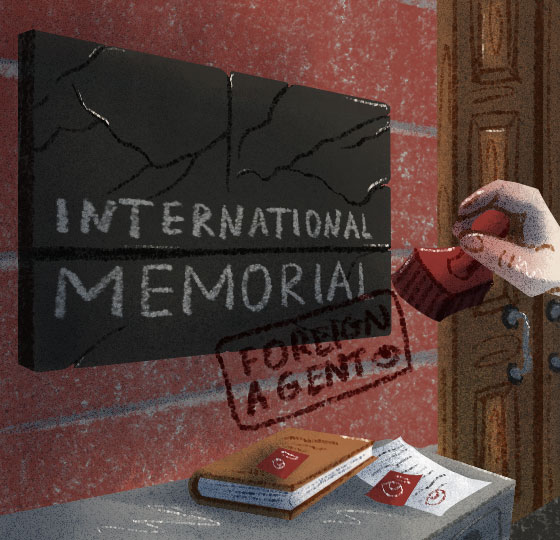
Russian government accused two of the country’s oldest human rights groups, International Memorial and Memorial Human Rights Centre, of violating the “foreign agent” law. The accusations were based on two facts: first, they didn’t have labels on their internet resources at a time when such labelling was not yet formally required; and second, they didn’t “stamp one book at a book fair with the standard notice” that it was produced by a “foreign agent”.
The Russian courts found that the organisations had committed “gross and repetitive” violations of the “foreign agent” labelling requirements and ordered both NGOs to shut down.
Which human rights were violated in the Memorial case? You can select multiple answers.
Correct answers are:
Article 10 - Freedom of expression
Article 11 - Freedom of peaceful assembly and association”
Explainer:
The European Court of Human Rights emphasized that shutting down an organization is the harshest punishment and should be used only in exceptional cases, but in this case, it was used arbitrarily to punish and intimidate International Memorial and Memorial Human Rights Centre.
In addition, the Court explained that the right to freedom of expression includes both the right to express ideas and the right to remain silent. By forcing the applicants to attach the “foreign agent” label to all their public communications and express a message with which they disagreed, the authorities violated this right.
Accordingly, the Court ruled that there has been a violation of Articles 10 and 11 of the Convention.
Good attempt. Here’s the correct answer:
The European Court of Human Rights emphasized that shutting down an organization is the harshest punishment and should be used only in exceptional cases, but in this case, it was used arbitrarily to punish and intimidate International Memorial and Memorial Human Rights Centre.
In addition, the Court explained that the right to freedom of expression includes both the right to express ideas and the right to remain silent. By forcing the applicants to attach the “foreign agent” label to all their public communications and express a message with which they disagreed, the authorities violated this right.
Accordingly, the Court ruled that there has been a violation of Articles 10 and 11 of the Convention.
Not quite — give it another try.
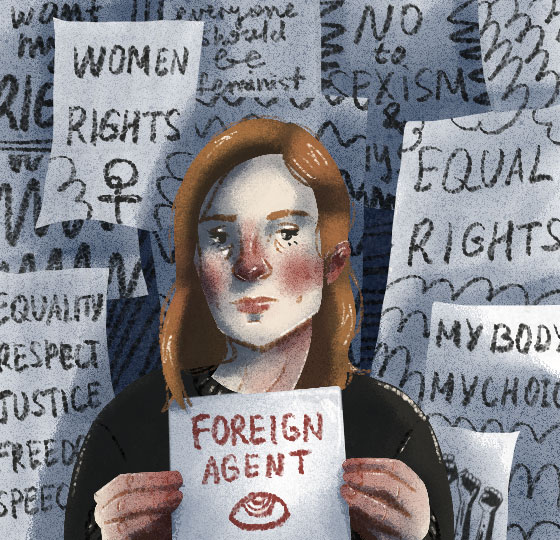
Darya Apakhonchich, women’s rights campaigner, was designated as a “foreign agent” for publishing feminist materials online, advocating for gender equality, and receiving indirect foreign funding.
Individuals designated as “foreign agents” complained that their names and personal information were published online, they had to provide extensive reports, and faced restrictions on their work, including restrictions of teaching children and writing for young audiences.
The applicants stated that this law targeted them because of their civic activities and political opinions.
Which human rights were violated in Darya’s case?
Correct answers are:
Article 8 - Right to respect for private life
Article 10 - Freedom of expression
Explainer:
Article 8 of the Convention protects the right to personal development and to establish relationships with others and the outside world. The Court noted that the individual applicants’ designation as “foreign agents” seriously affected person’s private and professional life, in violation of the European Convention of Human Rights.
Correct answers are:
Article 8 - Right to respect for private life
Article 10 - Freedom of expression
Explainer:
Article 8 of the Convention protects the right to personal development and to establish relationships with others and the outside world. The Court noted that the individual applicants’ designation as “foreign agents” seriously affected person’s private and professional life, in violation of the European Convention of Human Rights.
Understand “foreign agents’” legislation as a dangerous authoritarian practice
Great work! You have clearly identified which specific human rights were violated by the Russian “foreign agents” legislation.
Now, let’s explore why such authoritarian practices are dangerous for individuals, civil society, and the foundations of human rights.
Let’s chat with the professor of International Human Rights Law to learn more.
RESPONSE OPTIONS
RESPONSE OPTIONS+
Hello professor, I’m learning about the dangers of the “foreign agents” legislation, and I have a few questions that I would like to ask based on the case KOBALIYA AND OTHERS v. RUSSIA.
Hello dear learner. Sure, feel free to ask and I’ll be happy to answer!
Russian legislation doesn’t actually require evidence of any actions undertaken in foreign interests by the “foreign agents”. In fact, the Russian authorities provided no such evidence in any of the 107 cases considered by the Court. This fundamental flaw has created a false impression of foreign interference where none had been shown to exist. It undermines any possible justification.
The arbitrary use of the stigmatising and misleading label of a “foreign agent”, requirements to use it in public communications and strict sanctions for violating this law aimed to silence critical voices and created a “chilling effect” on civil society and public debate. Simply speaking, more people become afraid to speak out.
According to opinion polls, the majority of the Russian population associated the term “agent” with negative concepts such as “traitors,” “spies” or “enemies of the people”. This label suggested that they were under foreign control, although these organisations saw themselves as important parts of the national civil society. In addition, new restrictions on “foreign agents" excluded them from various aspects of public life and activities, like educating or organising public events. This made them look even more as a threat to society that should be kept away from sensitive areas. Therefore, being labelled this way strongly influences how people see these organisations and individuals.
NGOs, media organisations and journalists perform important role in the society as “public watchdogs”. Russian authorities censored and suppressed the designated organisations and individuals, in order to silence criticism, restrict freedom of expression and weaken those who hold the government to account. Moreover, they were required to use the “foreign agent” label in all public communications, a practice of forced self-stigmatisation. People had to put “I am a foreign agent” notice even on Facebook posts with birthday wishes to their friends to avoid fines. This is what the Court described as “hallmarks of a totalitarian regime.”
By weakening civil society, the government supresses criticism and restricts oversight of their actions by independent voices. This gives them power to limit domestic and international scrutiny. Such laws undermine international human rights mechanisms and principles by associating working with global partners as “foreign interference” and “spying”. The suppression of opposition and critical voices allows greater scope for governments to commit human rights violations without facing any consequences.
Under Russian law, receiving any kind of support or influence directly from non-nationals or even indirectly through Russian nationals (even consultation or guidance!) automatically creates the assumption that an organisation or individual is acting as an “agent”. Authorities do not have to prove any real connection to the recipient’s activities, giving them overly broad power to apply the “foreign agent” label.
Sure! For example, the independent election monitoring organisation, League of Voters Foundation, was fined, designated as a “foreign agent” and liquidated for a donation of less than EUR 3, which could not even be verified as coming from a foreign national.
Civil Initiative Against Environmental Crime was fined for failing to register as a “foreign agent”. Their "political activities" included a forest fire monitoring project, and the "foreign funding" was from Greenpeace Council.
Artem Vazhenkov, an independent election observer, was designated for cashing his airline bonus miles with someone who happened to be a non-Russian national.
These are only a few examples among dozens of applications joined in this judgment.
According to opinion polls, the majority of the Russian population associated the term “agent” with negative concepts such as “traitors,” “spies” or “enemies of the people”. This label suggested that they were under foreign control, although these organisations saw themselves as important parts of the national civil society. In addition, new restrictions on “foreign agents" excluded them from various aspects of public life and activities, like educating or organising public events. This made them look even more as a threat to society that should be kept away from sensitive areas. Therefore, being labelled this way strongly influences how people see these organisations and individuals.
NGOs, media organisations and journalists perform important role in the society as “public watchdogs”. Russian authorities censored and suppressed the designated organisations and individuals, in order to silence criticism, restrict freedom of expression and weaken those who hold the government to account. Moreover, they were required to use the “foreign agent” label in all public communications, a practice of forced self-stigmatisation. People had to put “I am a foreign agent” notice even on Facebook posts with birthday wishes to their friends to avoid fines. This is what the Court described as “hallmarks of a totalitarian regime.”
By weakening civil society, the government supresses criticism and restricts oversight of their actions by independent voices. This gives them power to limit domestic and international scrutiny. Such laws undermine international human rights mechanisms and principles by associating working with global partners as “foreign interference” and “spying”. The suppression of opposition and critical voices allows greater scope for governments to commit human rights violations without facing any consequences.
Participation in a range of activities can result in the designation, such as broadly defined “political activities” or the “dissemination of information to the public”. This could include having a social media account or sharing the content created by others. Journalists are particularly vulnerable, because sharing information is their job. Forms of “political activity” include participation in public events, making appeals to authorities, conducting opinion polls and expressing opinions about the decisions and policies of the authorities.
Yes, there are!
Esvero Partnership for Support of Public-Health Initiatives – a harm reduction partnership for HIV and drug-users' services.
Genesis Social Development Foundation – NGO that assists in the rehabilitation of refugees and internally displaced persons.
Nasiliyu.Net – organisation educating the public about domestic violence and providing assistance to survivors.
Kolsky Environmental Centre – an NGO monitoring environmental damage.
Russian Lorry Drivers Association – a group of lorry drivers who campaigned against the introduction of a tolling scheme on heavy goods vehicles.
In certain cases, the directors or chairpersons of these organisations were also personally fined.
According to opinion polls, the majority of the Russian population associated the term “agent” with negative concepts such as “traitors,” “spies” or “enemies of the people”. This label suggested that they were under foreign control, although these organisations saw themselves as important parts of the national civil society. In addition, new restrictions on “foreign agents" excluded them from various aspects of public life and activities, like educating or organising public events. This made them look even more as a threat to society that should be kept away from sensitive areas. Therefore, being labelled this way strongly influences how people see these organisations and individuals.
You’re welcome! I’m happy you asked. Feel free to share this knowledge with your friends and spread the awareness.
NGOs, media organisations and journalists perform important role in the society as “public watchdogs”. Russian authorities censored and suppressed the designated organisations and individuals, in order to silence criticism, restrict freedom of expression and weaken those who hold the government to account. Moreover, they were required to use the “foreign agent” label in all public communications, a practice of forced self-stigmatisation. People had to put “I am a foreign agent” notice even on Facebook posts with birthday wishes to their friends to avoid fines. This is what the Court described as “hallmarks of a totalitarian regime.”
You’re welcome! I’m happy you asked. Feel free to share this knowledge with your friends and spread the awareness.
By weakening civil society, the government supresses criticism and restricts oversight of their actions by independent voices. This gives them power to limit domestic and international scrutiny. Such laws undermine international human rights mechanisms and principles by associating working with global partners as “foreign interference” and “spying”. The suppression of opposition and critical voices allows greater scope for governments to commit human rights violations without facing any consequences.
You’re welcome! I’m happy you asked. Feel free to share this knowledge with your friends and spread the awareness.
Great job! Let’s check how you understood the dangers and consequences of “foreign agents” legislation from your conversation with the professor.
When do authorities have legitimate reasons for refusing protests and when do they violate our human right to assemble peacefully? In this module, you will follow how ordinary citizens, whose protests were not authorised by Russian authorities, took their case to the European Court of Human Rights and won.
What obligations do states have in protecting us when we protest peacefully on the streets? In this module, you will find out how a group of activists in Georgia appealed to the European Court of Human Rights for a judgement in protecting their right to safely conduct a march against homophobia without fear of violent counter-demonstrators.
Your choice regarding cookies on this site
We have placed cookies on your device to help make this website better. You can use this tool to change your cookie settings. Otherwise, we'll assume you're OK to continue.